


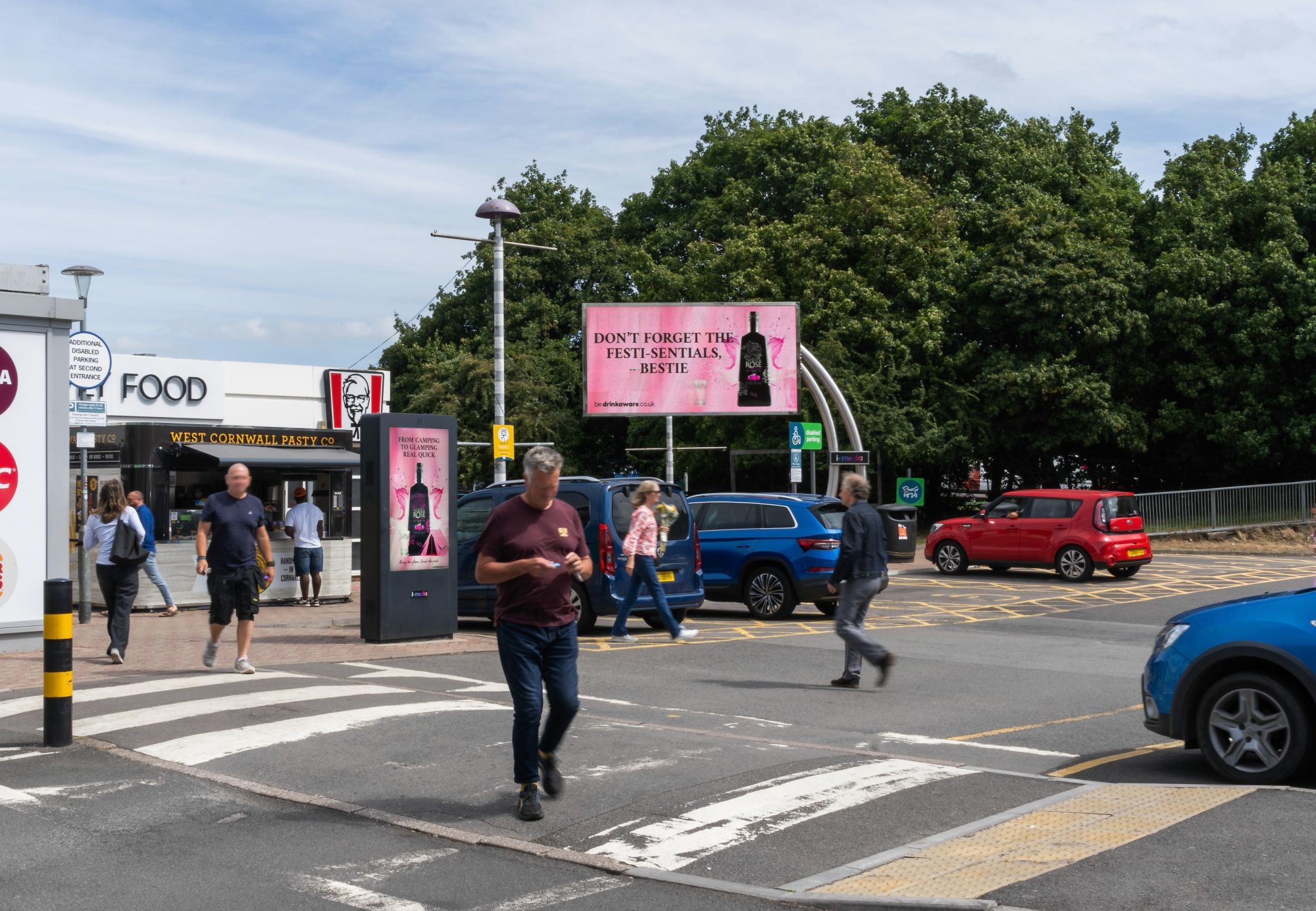
Every summer, hundreds of thousands of festival-goers load up their cars and take the same roads to the same places. The routes are predictable. The timing is predictable. The audience is predictable. And for the first time, it is fully visible.
+70%
turn-in uplift at Cobham on the M25
95%
of monitored MSAs recorded a positive return signal on Reading's homeward day
+55%
EPOS sales uplift the day after Creamfields
i-media's ANPR platform tracks festival audience movement across the Strategic Road Network in real time, matching footfall spikes at motorway service areas (MSA) to specific events, corridors, and days. As audiences travel to Leeds, Reading, Creamfields, and in previous summers Glastonbury, footfall builds sharply at MSAs that sit directly on their path. The data does not just show that festivals drive MSA traffic. It shows exactly where, exactly when, and exactly which roads carry that audience.
The pattern doesn't end at the festival gate either. The return journey produces its own commercial moment, distinct in timing, distinct in audience mindset, and measurable down to the individual site. For brands and media planners, the arrival and the return represent two different audiences in two different states of mind, both of them identifiable, both of them addressable on screen.
Thursday and Friday: the audience arrives
The signal starts before the festival opens. At Leeds Festival, every one of the seven MSAs on the A1/M1 corridor to Bramham Park saw positive uplift on both Thursday and Friday, with a combined +13% on Friday alone. Skelton Lake up 20%, Ferrybridge up 15%, Wetherby up 12%. That is not a network-wide trend. It is a convoy. 75,000 people taking the same road to the same place, visible at every service area they pass through.
For Creamfields, the M6 corridor north of Birmingham shows the same directional movement as audiences head towards Daresbury in Cheshire, with Lymm on the M6 recording a +8% uplift on Thursday.
Reading Festival's arrival signal is clearest on Thursday. Cobham on the M25 recorded a +70% uplift as festival-goers from London and the Southeast began their journey towards Berkshire creating the strongest single-site day of the summer.
The pattern holds every year and across every event. Our platform has tracked it consistently, including in previous summers at Glastonbury, where MSAs on the M4 corridor were on the move from Wednesday, with five sites recording a combined uplift of +20% as audiences from London, Wales, and the West converged on Somerset. The behaviour is the same. The roads are different.
The footfall uplift on Thursday and Friday is only half the story. Our Intelligent Platform's EPOS data shows that once festival audiences arrive on route, the commercial character of those MSAs shifts entirely for the duration of the weekend. Ice cream up 73%. Sports drinks up 45%. Suntan lotion up 337%. Within ice cream, Magnum led the category at +91%. These are not standard motorway purchases. They are a festival shop, concentrated at the exact sites those audiences pass through.
The routes are predictable. The days are predictable. The audience is predictable. Our Intelligent Platform sees all of it, which means the brands on screen at those sites, on those days, are not just reaching a general motorway audience but also reaching festival-goers in transit.


The return: the most valuable moment in the cycle
The return journey is the mirror of the arrival. And in some cases, the stronger signal.
Reading Festival’s return signal is the most consistent in the dataset. Nineteen of twenty monitored sites recorded positive uplift on the return day. Every M4 site positive, every M3 site positive, theM40 corridor up 21% with Oxford alone recording +25%. An audience that arrived from multiple directions converging on Berkshire, now dispersing back across the South, the Midlands, and London simultaneously.
This is not an isolated result. Our platform has tracked the same homeward pattern consistently across events. In previous summers, Glastonbury’s return Monday produced the largest single-day spike in our entire dataset, with Sedgemoor North up 31% and the M4 corridor moving at a combined +20% as audiences headed home across seven sites. Two different festivals, two different roads, the same behaviour.
And when they stop, they spend differently. The EPOS data shows a complete category shift on the return day. Energy drinks up 36% with Red Bull and Monster leading the category, water up 56%, fizzy drinks up 46%, crisps up 32%. RedBull, Monster, Buxton, and Doritos lead their respective categories. These are people who have spent three days in a field, stopping to rehydrate and refuel before the final stretch home. The purchase intent is specific, the dwell time is high, and our advanced ad-tech proves it.
What makes this commercially actionable is not just the data, it is what the data enables. Our advanced ad-tech combines footfall intelligence with till data, connecting the audience movement on the road with the purchase behaviour recorded at the till. The result is not an audience estimate. It is a real-time picture of who is on site, what they are buying, and what they are likely to buy next. This precision in data unlocks real-time targeting with the right ad, to the right audience, at the right moment in their journey.
Festival season is not a contextual opportunity. It is a plannable one. The routes are known. The days are known. The audience is known.The only question is whether the right brands are on screen when they arrive.
